
Germantown City Directory Shelf
Germantown's historical shelf is really a county and Washington-suburban shelf. It is not a complete municipal run. Germantown is unincorporated. Its farm and village history lives inside Montgomery County records. Some volumes are documented Germantown material; others sit on the shelf without confirmed Germantown pages. A catalog result proves a book exists. It proves nothing about whether a particular person, road, or household appears inside.
| Collection | Documented years | Where it is held | Reading route |
|---|---|---|---|
| T.H.S. Boyd Montgomery County directory | 1879 Germantown context | Montgomery History Digital Repository | Digitized record for Germantown research |
| Maryland White and Yellow Pages, Germantown entries | 1935 Germantown sample | Library of Congress | Digitized page and text |
| Nelson Washington Suburban volumes | 1912, 1916, 1917, 1918, 1923 | Local-history collections for Germantown research | Confirm Germantown pages in person |
| Polk Washington Suburban volumes | 1927–28, 1930–31 | Reference collections for Germantown research | Regional Germantown reverse clues |
| Klinge atlases and Lusk directories/maps | 1931–1959; 1951–1993 | Montgomery History maps collections | Germantown street and property context |
| Montgomery County Sentinel | 1855–2020 | Montgomery History and Rockville Memorial | Germantown research by digital, computer, or microfilm |
The obvious gap is a Germantown-only city directory series. Nelson and Polk documented years are regional works. Their finding aids publish no Germantown page ranges. Every result deserves a note recording publisher, year, repository, and page. The Maryland Archives city-directory catalog handles a topic-and-date search well. It simply offers no complete Germantown-only run.
Reading a Germantown Directory Entry
Treat a Germantown entry as a printed observation. It is not a verdict. The 1935 sample shows a name, a title, and a residence notation. Other regional books can add an address, telephone, business, or reverse-section listing. That extra detail appears when the right page survives. Occupation, spouse, and owner or renter marks show up in some systems. Not every volume carries those fields. Photograph or transcribe the key page plus its abbreviation list. Expand any mark in your notes only after that step.
| Name as printed | Preserve initials, title, and spelling; use variants only as later search terms. |
|---|---|
| Residence notation | A locality or brief residence marker may be a lead, not a complete street address. |
| Address or telephone | When printed, compare it with the year and the source's own abbreviation key. |
| Occupation or business | Useful for separating same-name people, but not proof of a present-day identity. |
| Household notation | A title, spouse, widow, or relative notation can guide a census or obituary search. |
- Criss-cross directory
- An address- or street-ordered section that can lead from an old location to a listed name. Its coverage and notation depend on the volume.
- Householder index
- An index organized around the listed household name rather than a complete account of every person at a place.
- Abbreviation key
- The volume's own explanation of short marks. Capture it with the entry instead of guessing what a letter means.
Keep the page itself with the volume details. A county, regional, or telephone directory points toward a Germantown person or place. A deed, census, newspaper, or cemetery record supplies the independent check.
Germantown's County Directory Story
Germantown records change shape with the place. In 1879, a county directory could name Germantown post offices, farmers, merchants, and manufacturers. By the twentieth century, telephone and Washington-suburban books offered name and locality clues. Later, planned-community growth pushed plats, parcels, maps, and address sources to the fore. A historical directory locates a person in an era. It is not a modern resident roll.
County land records begin in July 1777. The modern Germantown street grid does not stretch back that far. For an old farm, road, or settlement label, read the legal description. Read the map alongside the directory too. Montgomery Planning's historic material preserves many old names. These include Waring-Crawford Farm, Pleasant Fields/Basil Waters House, and Waring Station Road. Use those names as search terms across maps, deeds, cemetery cards, and newspapers. A matching surname alone proves no kinship.
- 1777: the county land-record universe begins, with equity index books later described for 1777–1981.
- 1879: Boyd captures a county farm, post-office, merchant, and manufacturer snapshot.
- 1912–1931: documented Nelson and Polk Washington Suburban volumes add regional directory years.
- 1935: the inspected Maryland telephone page shows a Germantown residence lead in compact form.
- After the planned-community era begins, plats, SDAT, deeds, aerials, and GIS become stronger address crosswalks.
Note: The county publishes no Germantown-specific courthouse-loss record or street-renumbering crosswalk.
Boyd's 1879 Germantown Directory
The earliest concrete sample is the digitized T.H.S. Boyd Montgomery County directory. It serves the Germantown farm and village era, before the planned community took shape. A Boyd entry can point to a locality connection, an occupation, a post office, or a business. It cannot prove that every Germantown resident appeared. Nor can it become a current street address.
Copy the name exactly, keep initials and spelling variants, and record the page with the year. Then test the person or place against a deed, tax list, census, church record, or Sentinel notice. Several county residents share surnames. That habit preserves the evidence trail. Montgomery History's digitized Boyd item displays the 1879 county directory in full.
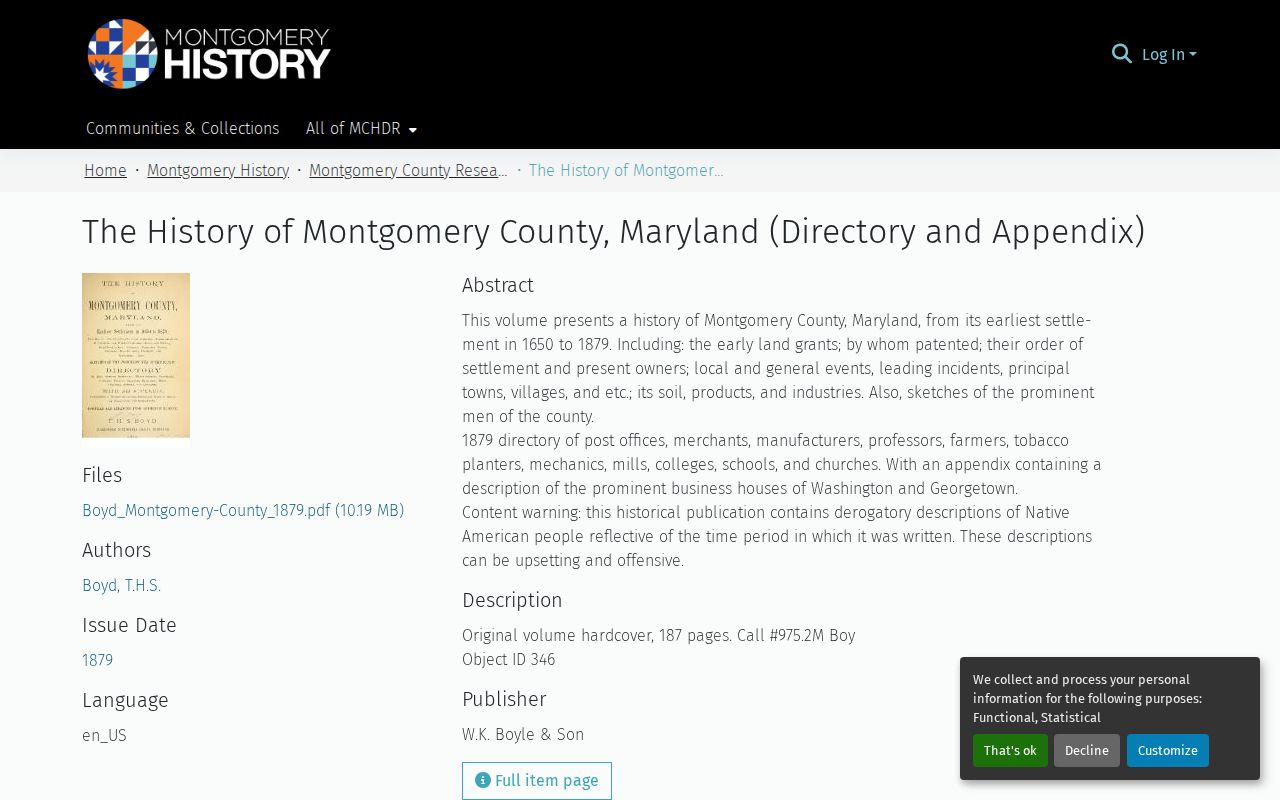
The collection view identifies the source and year. Confirm both before citing any specific line.
1935 Germantown City Directory Clues
A 1935 Maryland White and Yellow Pages page yields a concrete Germantown household lead. Its compact pattern prints the name, sometimes a title or marital marker. Then comes a short residence tag with the locality. It offers no reliable street number, parcel, or birth date. It cannot prove anyone stayed put. Nearby lines still help with spelling and household context.
Keep abbreviations exactly as printed. A locality label often works better as a bridge to a census, deed, or newspaper. Use it that way rather than as an address. Save the date and page image with every line you cite. Remember that directories record a community affiliation, not a structured profile.
Germantown Directory Books After 1912
Nelson Washington Suburban finding aids cover volumes for 1912, 1916, 1917, 1918, and 1923. Polk Washington Suburban holdings run from 1927–28 and 1930–31. Both are regional Germantown city directories. Each volume has to be opened. It must be checked for the actual Germantown range before a name can be reported. Their worth is in possible Germantown address-to-occupant, telephone, business, and criss-cross clues. Universal county coverage should never be assumed.
Lusk real-estate directories and maps span 1951 to 1993. Klinge atlases cover 1931 to 1959 in the Montgomery History maps collection. Together they give Germantown property and street context for a residents directory lead. A map can show a Germantown road or a development pattern. It cannot prove a named person lived on the parcel. For that, a deed or property record still does the work. The Montgomery History collections overview sits these mapped and real-estate channels together. It also places them beside its wider historical holdings.
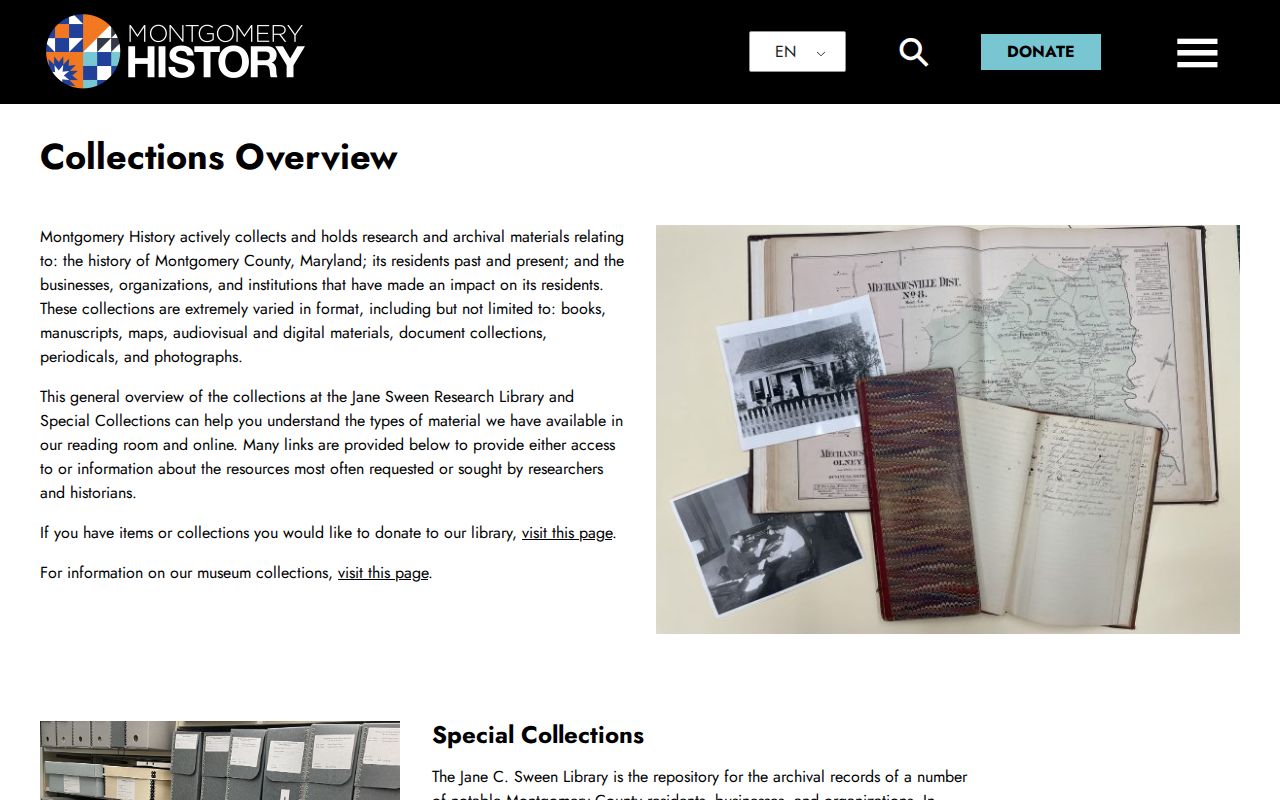
Printed directory clues gain force when set beside maps, newspapers, cemetery material, and county records.
Germantown Directory Reading Rooms
The Germantown Library is the practical local stop for residents directory questions. Ask there about county directories, yearbooks, newspaper databases, genealogy resources, and interlibrary loan. Posted hours are Monday through Thursday, 10:00 a.m. to 8:00 p.m. Friday through Sunday, they are 10:00 a.m. to 6:00 p.m. Holiday and seasonal changes are possible. A reference-desk request can often surface material no branch page lists.
Montgomery History keeps the deeper county shelf. Its holdings cover genealogy books and land and tax material. Census, church and cemetery collections, newspapers, maps, and vertical files round out the collection. Its archive at 8540 Anniversary Circle in Gaithersburg works by appointment at no charge. Visitors may photograph or scan under reading-room rules, though there is no photocopier. Its research service is a fallback when a volume or file cannot be consulted independently. The Germantown Library location page is the natural first stop before any in-person visit.
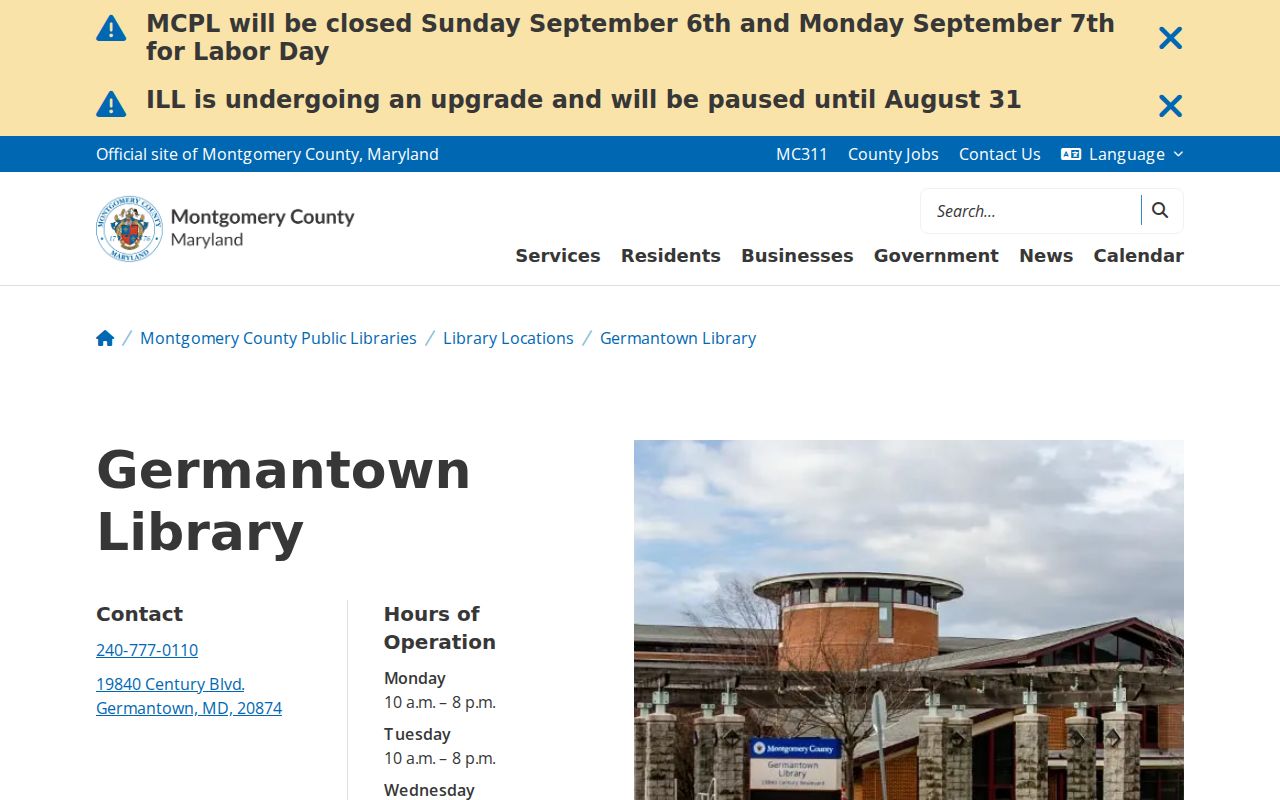
Think of the library as a request point for the right volume or database, not as proof that every historical directory is already online.
Germantown Directories Meet the Sentinel
Why does a name change or vanish from a directory? The Montgomery County Sentinel often answers that. Montgomery History documents coverage from 1855 through 2020. The 1855–1863 run is digitized through Chronicling America. The 1964–1969 issues sit at reading computers. And 1970–2020 is on microfilm at Rockville Memorial Library. Malloy and Bowman abstracts add obituary leads. Still, the newspaper date and page remain the stronger evidence.
An obituary or legal notice can name a spouse, parent, executor, church, funeral home, or former address. Common surnames and repeated initials make source-page checking essential. The Montgomery History Sentinel guide lists the access channels for the paper and its abstracts.
Note: An obituary abstract is only a lead. Confirm details against the newspaper page and another record when possible.
Tracing Germantown City Directory Households
Treat a residents directory trail as a sequence of dated snapshots. Start with the exact printed name, locality, and page. Then search both the prior and next documented years. A move or a widow notation can reveal more than one lone appearance. So can a business line or changed initials. Federal census schedules, released under the National Archives 72-year rule, add household relationships, ages, and places. Expect disagreement between census and city directory entries, since each captured different dates and boundaries.
- Copy the name, locality spelling, printed notation, year, repository, and page from the first entry.
- Check the preceding and following directory years, recording moves, title changes, initials, and any residence or business notation.
- Use a criss-cross section only when that volume provides one, then retain the address and the volume's abbreviation key.
- Pair the date with the appropriate released federal census, comparing people and relationships rather than forcing an exact address match.
- Test the place through an SDAT/deed legal description, map, or historic aerial when the road may have changed.
- Use a Sentinel notice, probate record, cemetery card, or church source to investigate a disappearance, death, or surname shift.
For a post-1950 address, several companions help. Lusk and Klinge materials, Sentinel microfilm, and tax maps all earn a place in a resident lookup. County aerials and the Germantown Historical Society do too. The Historical Society finding aid describes paper and digital records, maps, photographs, and microfilm. Together they cover 1900 to the present. A historical directory supplies the name-date connection. A deed or parcel source better tests whether the place itself matches.