
Germantown Postal ZIP Coverage
USPS ties three ZIP codes to Germantown, Maryland: 20874, 20875, and 20876. The recommended mailing label is Germantown, MD. That label is a convenience for mail, nothing more. It does not define the Germantown Census-Designated Place. Nor does it mark a county planning area, a parcel, or any municipal line. This Germantown postal reference keeps the confirmed ZIP relationship apart from street-level coverage. No static official table publishes that coverage. Treat the label as a starting point, not a boundary.
| Germantown ZIP | Germantown areas covered | Germantown postal-city label | Germantown verification note |
|---|---|---|---|
| Germantown 20874 | Germantown postal delivery area; much of the commonly addressed CDP uses it | Germantown USPS recommended label: Germantown, MD | A public Germantown parcel sample used this ZIP. Confirm the exact Germantown address, street, and subdivision live. |
| Germantown 20875 | Germantown-associated postal ZIP in the official Maryland list | Germantown USPS recommended label: Germantown, MD | Germantown static official material did not identify its exact streets, station, or PO-box status. |
| Germantown 20876 | Germantown-associated postal ZIP in the official Maryland list | Germantown USPS recommended label: Germantown, MD | Germantown static official material did not identify its exact streets, station, or PO-box status. |
No row here is a resident list. Delivery area, branch or station, PO-box classification, and neighborhood edge all have to be checked for the specific address in question. A broad ZIP label cannot assign a person, parcel, or community association to one side of a road.
Verify a Germantown ZIP With USPS
The official USPS ZIP Lookup offers address, city-and-state, and cities-by-ZIP modes. Enter the full address whenever you can. That returns a normalized form plus its postal relationship. City-and-state mode helps when the street number is a mystery. Keep in mind what a result proves. It shows the postal label and routing relationship, not that any person or group sits at that address. The USPS city-and-state screen is the authority behind this Germantown postal check.
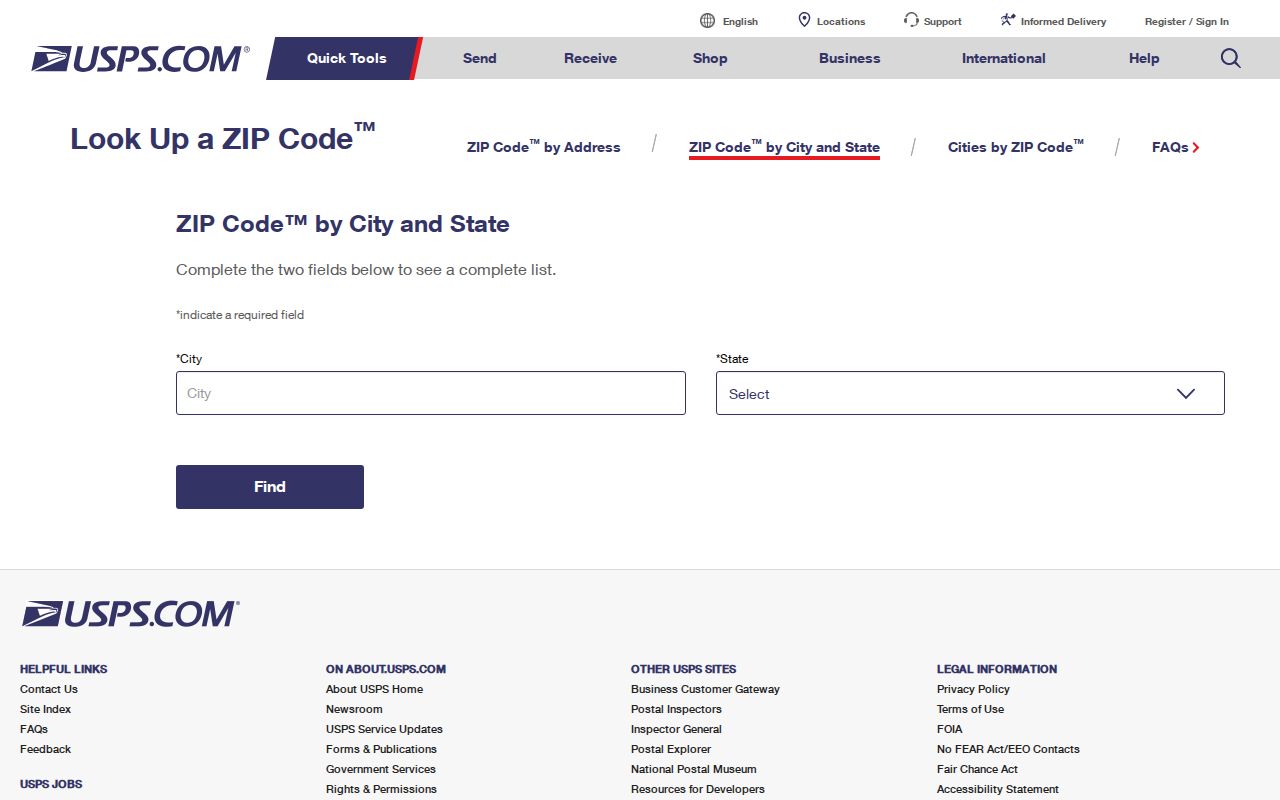
Save the returned city spelling, ZIP, and normalized street form before touching county records. That one habit cuts down failed searches from abbreviations, directions, suffixes, or older address forms. It also stops you from mistaking an old directory's address order for a current USPS result.
Germantown ZIP Portal Keys
Local systems treat ZIP codes differently. USPS treats one as a delivery key. Maryland Voter Search treats it as a required identity field. County GIS can carry a premise ZIP inside property data and may filter address-city or ZIP fields where configured. SDAT and MDLandRec lean on other keys altogether. Matching the portal to its own search key beats pasting a ZIP into every form on the screen.
| Germantown official portal | Germantown ZIP support | Germantown ZIP use | Germantown ZIP limit |
|---|---|---|---|
| Germantown USPS ZIP Lookup | Germantown address, city/state, and cities-by-ZIP | Germantown postal-address normalization and city/ZIP candidate | Germantown occupancy proof or resident roster |
| Germantown Maryland Voter Search | Germantown required name and date of birth | Germantown supplied identity record review, polling, and district information | Germantown browse of all voters in a ZIP |
| Germantown Montgomery GIS | Germantown premise ZIP fields in property data | Germantown parcel and service context for an address | Germantown general resident list |
| Germantown Maryland SDAT | Germantown no ZIP search | Germantown parcel after address, PAN, or map-and-parcel search | Germantown return of all properties in a ZIP |
| Germantown MDLandRec | Germantown no modern ZIP-wide search | Germantown instruments by party, book/page, date, or legal description | Germantown deeds by a ZIP label |
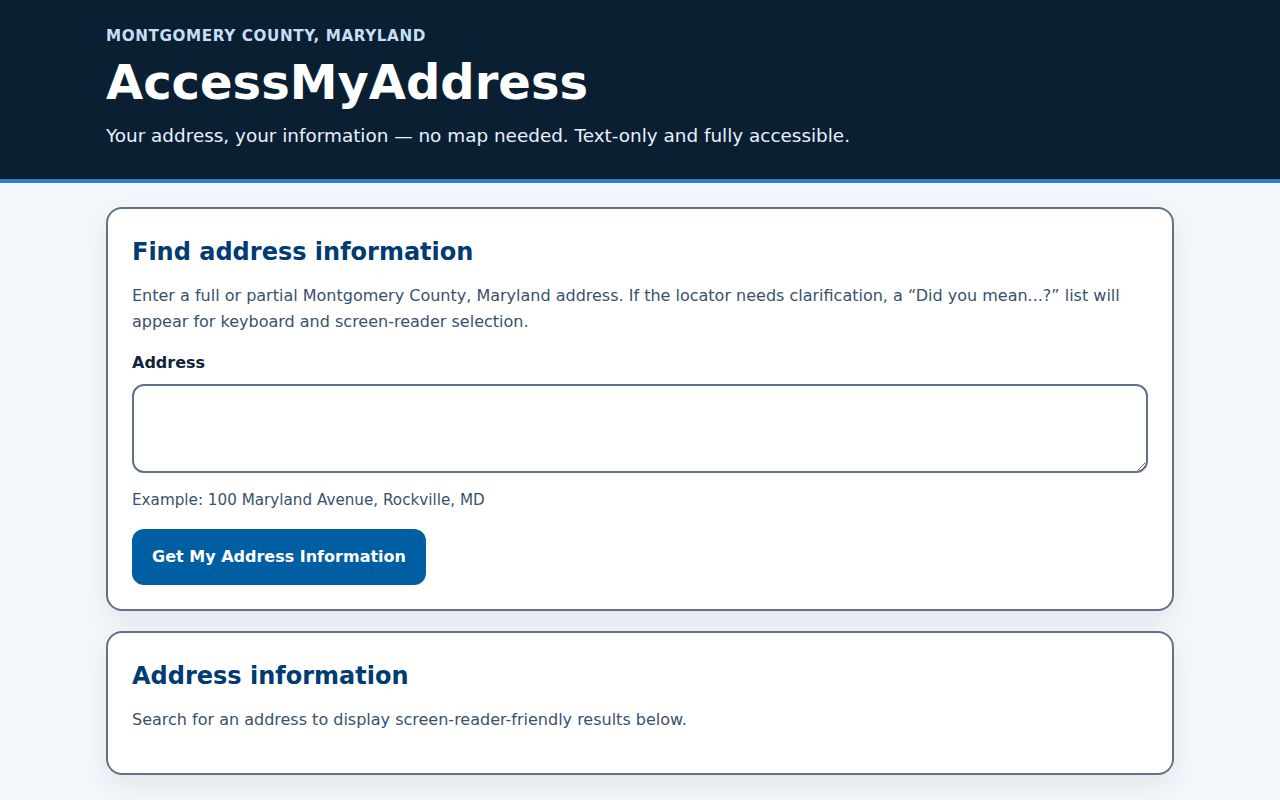
AccessMyAddress works the same way, from an exact address. After a postal result normalizes the address, its county output layers on school, planning, service, community, election, council, watershed, and census context. Those layers describe a place. They say nothing about a household.
Search Within a Germantown ZIP
A ZIP narrows a postal question. It does not unlock any ZIP-wide property or land-record search. The dependable path runs from the postal result to the exact address, then into the county or state index that recognizes that address. That sequence keeps postal geography from being mistaken for a parcel, district, or resident boundary.
- Use USPS to confirm the ZIP and normalized form of the full address, or use city and state to identify a candidate ZIP when the address is incomplete.
- For an exact location, enter the normalized address into AccessMyAddress. Review the county service, planning, community, district, and census results.
- Use the address, property account, or map-and-parcel path in SDAT. SDAT cannot search a whole ZIP, town, neighborhood, subdivision, or owner name.
- When a supplied person's full name and date of birth are available, use the confirmed ZIP in Maryland Voter Search. Treat a non-match as a possible spelling, former-name, recent-move, or protected-record issue, not a conclusion about registration.
- For a recorded transfer, take the SDAT or GIS deed reference into MDLandRec. For a dated occupant clue, use historical directories, newspapers, census releases, or the library route.
Once a ZIP search narrows to a particular road, hand off to the Germantown street directory for the parcel, GIS, and land-record walkthrough. Street-level evidence starts earning its keep right there, past the limits of the postal label.
Germantown ZIP Voter Fields
Maryland Voter Search shows the split between a ZIP as a match field and a ZIP as a list filter. The individual form demands first name, last name, date of birth, and a five-digit ZIP. Middle initial and street number stay optional. A successful match can lead to record review, voter-card, polling place, district, local-board, and mail or provisional status details. It never exposes ballot choices. Nor is it an invitation to compile a street-by-street list of neighbors.
| Voter Search field | Form type | Required | ZIP-related use |
|---|---|---|---|
| First name | Text | Yes | Enter the registration name. |
| Last name | Text | Yes | Hyphens and spaces are allowed by the form. |
| Date of birth | Date or text | Yes | Use the required date format shown on the form. |
| ZIP code | Text | Yes | Use the registration ZIP, not a guessed postal city. |
| Middle initial | Text | No | Use when known to narrow a match. |
| Street number | Text | No | Optional confirmation field, not a ZIP-wide street browse. |
The Maryland polling-place lookup instead takes street number, street name, and ZIP for an address-level check.
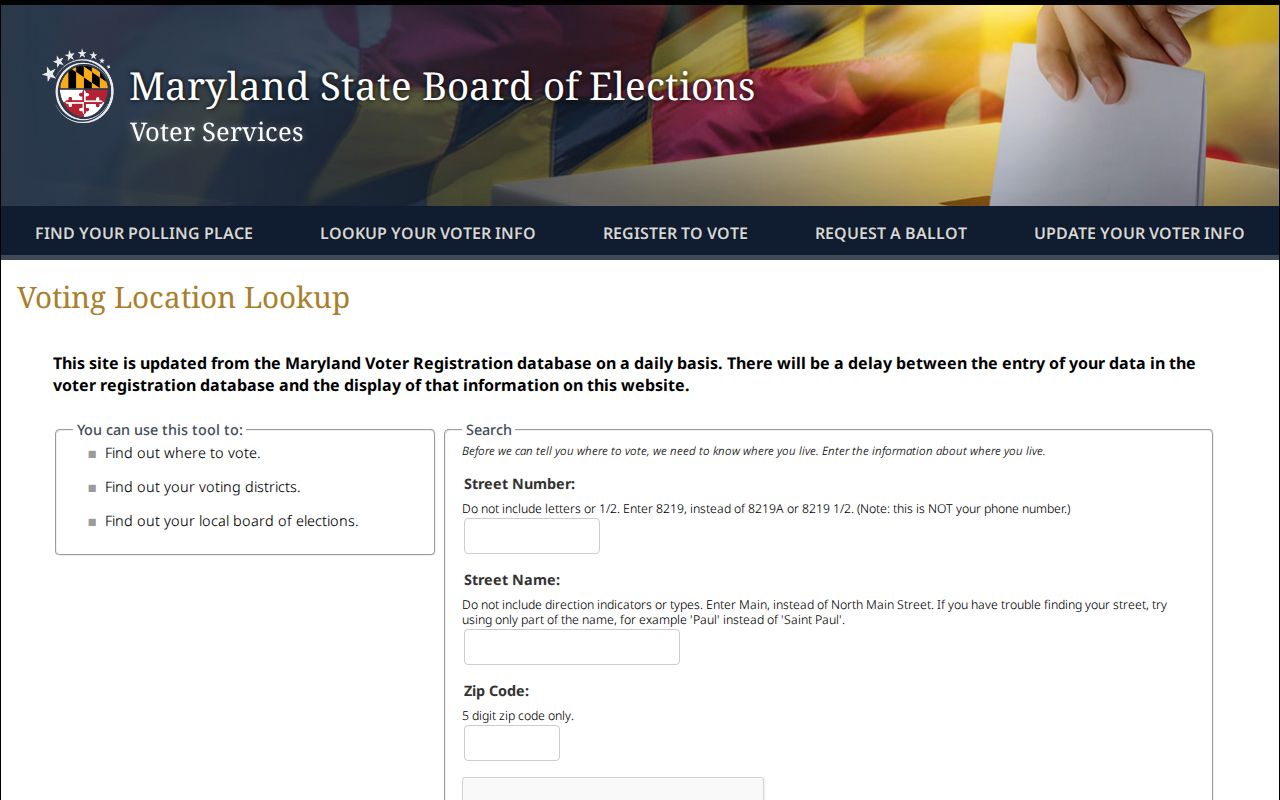
The state updates records daily, though online or motor-vehicle changes can take up to three weeks to appear. A recent move may call for the prior ZIP or a former surname. Full voter-file requests carry separate oath, fee, qualified-purpose, and protected-voter requirements under Maryland Election Law §3-506.
20874 Germantown Parcel Context
A public county property-service sample explains why an address beats a ZIP. The sample sat in 20874 and carried an account, premises address, liber/folio, transfer data, a Germantown Station subdivision and lot, year built, assessments, occupancy code, and district fields. No individual owner name appeared in the republished record. What it really demonstrates is an address-to-parcel-to-deed crosswalk, not a claim about the people living there. The county address lookup is the sensible next step once the postal label checks out.
For scale, 2019 Montgomery planning material counted 94 common-ownership communities inside ZIP 20874. It also tallied 18,506 units. That figure is dated community data, not a current resident count. It also describes a different geography than the 2020 Germantown CDP population of 91,249. Never swap one number for the other.
Germantown ZIP Codes Are Not City Limits
Germantown is not an incorporated city. No municipal boundary lines up with a postal ZIP. It is a Census-Designated Place inside Montgomery County. That distinction matters. Police and fire service areas, school zones, and council districts can each slice one neighborhood a different way. Watersheds, parcels, and postal delivery routes can cut it in yet other ways. A Germantown mailing label works well for mail and some identity forms. Treat it as a postal convenience, though. It is not proof of a city office or a jurisdiction.
- ZIP versus ZIP+4
- A five-digit ZIP identifies a postal delivery area. ZIP+4 adds a narrower delivery segment; neither is a parcel boundary or proof of occupancy.
- PO-box ZIP
- A ZIP used for post-office-box delivery. The reviewed static material did not confirm whether 20875 or 20876 has that status, so verify it live.
- Unique ZIP
- A ZIP assigned to one organization or facility. No Germantown-associated ZIP was verified as unique in the research.
- Carrier route
- A postal delivery sequence within a ZIP. It is useful to mail routing, but it is not a public resident directory.
Boundary check. Use USPS for delivery labels and county GIS for parcel and service context. When the two describe different geographies, retain both rather than forcing one boundary onto the other.
Germantown ZIP Address Forms
One Germantown property record can hold several address-like fields, and each means something different. The mailing address is where tax notices go. It may sit somewhere other than the property itself. The premises or situs address pinpoints the parcel on the ground. The legal description anchors land to its recorded identity. It does so through lot, block, subdivision, acreage, adjoining owners, or metes-and-bounds language. SDAT and GIS tie current addresses to those parcel keys, while MDLandRec follows the trail of party names, book and page, and legal descriptions.
This becomes useful when an old address fails to return an exact portal match. Set the current USPS-normalized form beside the premises field. Then hunt for the property account, parcel, plat, liber and folio, and legal description. A city label or ZIP can change over time. Those record identifiers preserve the continuity instead. Note: Map geometry is approximate and should not replace a recorded plat or survey.
Historic Germantown Addresses Before ZIP Codes
Old directories resist modern ZIP searching. The postal system and road network did not always carry today's labels. Period sources hold the clues instead. The 1879 Boyd county directory and Nelson and Polk Washington Suburban volumes can yield era-specific address or name hints. So can a 1935 Maryland telephone page, Lusk real-estate directories, Klinge atlases, the Montgomery County Sentinel, maps, and aerials. Their coverage is regional or partial, though. An old street number may not match a current parcel card.
Place old labels beside the current postal result. Then search plats and deeds by road, adjoining owner, lot, subdivision, and legal description. Montgomery Planning's timeline runs from farm-era Germantown through the I-270 corridor and planned-community growth. That history explains why a former road or farm name can be a stronger historical key than any ZIP. When a portal cannot resolve the older form, the library, Montgomery History, the Maryland State Archives, and a Public Information Act request remain the documented fallbacks.
Verify Germantown ZIP Code Gaps Live
No official static source publishes a dated Germantown ZIP realignment. Nor does one publish a ZIP split, exact neighborhood boundaries, or ZIP-by-ZIP population. There is also no firm station and PO-box classification for all three ZIPs. Do not infer any of those details from a Census-Designated Place total or a single parcel result. Run a live USPS address check first. Then compare the normalized address against county GIS and the parcel record.
If an old label seems to have changed, bring in Montgomery aerials, Lusk and Klinge maps, historical directories, plats, deeds, and the legal description. When those sources still do not answer the question, ask the county GIS or addressing office for the relevant record through a Maryland Public Information Act request. That approach keeps the useful ZIP clue intact. It does so without inventing a boundary history the official sources never documented.