
Germantown Previous Residents by Era
One Germantown address can carry several parallel histories. Montgomery land records hold the recorded Germantown ownership chain. Regional Germantown directories and census schedules add household clues from the past residents of Germantown era they cover. Old Germantown maps and aerial photographs test whether a road, a building, or a subdivision actually existed in a given year. Keeping those Germantown functions separate matters. In Germantown, the rural landscape, the regional directory era, and the planned-community era each describe locations differently, so a single source rarely answers every question.
| Source | Documented era | Where held | What it can show |
|---|---|---|---|
| Montgomery land records for Germantown | July 1777 to present record universe | Montgomery Circuit Court for Germantown, MDLandRec, Archives T5190 | Recorded parties, instruments, and legal descriptions |
| Boyd county directory | 1879 Germantown context | Montgomery History Digital Repository | Germantown post-office, farm, merchant, and locality clues |
| White and Yellow Pages, Germantown entries | 1935 Germantown sample | Library of Congress | Name, title, and Germantown residence lead |
| Nelson and Polk regional volumes | 1912–1931 documented issues | Local-history reference collections for Germantown | Regional Germantown name, address, and reverse clues |
| Klinge, Lusk, and aerial material for Germantown | 1931–1993; aerial years vary | Montgomery History and county GIS | Germantown road, parcel, and development chronology |
| Sentinel and federal census for Germantown | 1855–2020; released census years | Montgomery History, libraries, National Archives | Germantown household, obituary, legal-notice, and family leads |
Start a recent Germantown parcel with SDAT and its current deed reference. An older farm-era road needs a different entry point. Use the legal description, an old map, and a party name rather than forcing a modern number into an older index. Montgomery County publishes no complete Germantown street-renumbering crosswalk. There is no Germantown-specific Sanborn run either. Treat those gaps as a reason to compare sources, not as permission to assume continuity from one era to the next.
Start a Germantown Previous Residents Trail
The Maryland State Department of Assessments and Taxation goes by SDAT. It is the first authoritative crosswalk for a current Germantown premises address. Select Montgomery County. Then search by Germantown street address, property account identifier, or map and parcel. SDAT offers no owner-name, town, neighborhood, subdivision, or ZIP searching. Save what it does give you. The Germantown premises address comes first. So does the owner-of-record line. You also get the mailing address, the account or PAN, the transfer date, the legal description, the subdivision or lot, and the deed reference.
The Germantown mailing address is where a tax notice goes. The premises address identifies the parcel itself. Either one can differ from where an owner actually lived. Neither lists every occupant of the home. Use the SDAT Real Property Search as the Germantown parcel bridge. Then confirm the recorded instrument rather than treating an assessment line as an occupancy list.
Germantown Previous Residents Deed Chain
A recorded Germantown ownership trail starts at the current parcel reference. From there it moves backward one transaction at a time. MDLandRec supports county, party, date, document, and book and page searching. Party controls cover both grantor and grantee. Last-name options include Is, Begins, Ends, Contains, Fuzzy, and Soundex, which helps with old spellings. Remember that a modern Germantown street address is not the deed index's primary key. The stronger Germantown path runs from current parcel reference to deed. Then it goes from seller to earlier purchase.
- Find the exact Germantown premises address in SDAT and record the owner line, PAN, transfer data, legal description, lot, subdivision, and deed reference.
- Open the referenced Germantown instrument in MDLandRec with Montgomery County plus book/page or party and date controls. Save the grantor, grantee, date, instrument type, consideration, and legal description.
- Search that Germantown deed's seller, the grantor, as a grantee with a narrowed date. This can locate the seller's earlier purchase of the same land.
- Repeat backward, matching Germantown lot, acreage, plat, subdivision, road, adjoining owners, and any “being the same land” wording rather than trusting a street number alone.
- Follow a cited earlier Germantown book/page directly. For pre-index or equity material, consult Archives Guide T5190, courthouse books, or a written records request.
- Use the GIS property layer to compare the Germantown legal parcel, Liber/Folio, lot, subdivision, year built, and modern footprint before joining a deed to an address.
- Grantor
- The party conveying an interest in a Germantown deed, usually the seller in an ordinary transfer.
- Grantee
- The party receiving the recorded Germantown interest. Searching an earlier seller as grantee is the backward-chain step.
- Chain of title
- The sequence of recorded Germantown transfers for the same land, checked with the same parcel identity across each deed.
- Legal description
- The Germantown deed's land description, such as lot, block, subdivision, acreage, or plat reference. It is more stable than an old street number.
Searching old Germantown deeds gets easier once you know the controls. MDLandRec's search guide lays out the name, date, party, and book/page fields deed researchers lean on.
Those filters help narrow a recorded-party search in Germantown. Still, they cannot transform the deed index into a street-by-street household directory. Treat the index as a land-record tool, not a resident lookup.
Germantown Deed Images and Workstations
The current MDLandRec access guidance spells out remote accounts, image access, and workstation use. Remote Germantown access changed with MDLandRec Version 5 in fall 2025. Every remote user, new or existing, must set up a fresh account. Free image viewing still works at the Maryland State Archives and at local clerk workstations. Purchased pages follow the portal's own rules.
The county's Land Records/Public Information Room is a practical fallback. Montgomery County's land-record instructions place it in the North Tower. It sits on the second floor, Room 2120, at 50 Maryland Avenue in Rockville. Published public hours run Monday through Friday, 8:30 a.m. to 4:30 p.m. Regular copies cost $0.50 per page. Certified and triple-seal copies carry added fees. A Maryland Archives mail order covers one record, name, year, and place per request. The current form and charge govern that service.
Note: Confirm current hours, payment rules, and any remote-image charges. Rely on a copy route only after that check.
Germantown Addresses Change, Land Persists
Germantown roads mix farm-era corridors with railroad and viaduct references. Planned-community streets add a newer layer. The county has no definitive Germantown-wide renumbering or annexation year on record. So an old Germantown directory locality, a farm name, or a road label may beat a modern address as a lead. Before deciding two records describe the same place, compare the deed's legal description against a plat. Also check lot and subdivision details, acreage, adjoining owners, and a historic map.
Waring-Crawford Farm and Germantown Waring Station Road prove the point. Historic material ties the farm-house chronology to the road. The I-270 era reshaped the surrounding Germantown road context. Search only the current street label and you risk missing a newspaper item or deed filed under a former road, farm, or owner. These historical names are research keys for past residents. They are not shortcuts to a full household list.
Germantown Previous Residents and Maps
Maps and aerials date the land, not the households on it. Montgomery History catalogs Klinge atlases from 1931 to 1959. It also lists Lusk real-estate directories and maps from 1951 to 1993, plus aerial tax maps for 1969, 1972, 1974, 1979, 1980, and 1981. County GIS adds Germantown historical imagery for 1951, 1970, 1979, 1993–96, 1998, 2000, and 2002. Current views appear there too. Together they show whether a Germantown road, subdivision, or roof footprint existed at a given moment.
Germantown itself has no confirmed Sanborn run. Some Montgomery County towns carry Sanborn coverage through 1963. Yet that coverage never reached every structure. A map works best beside deeds, directories, permits, and aerial imagery, each supporting the others. No single source pins down when past residents of Germantown moved in.
Montgomery History's maps and atlases page names the documented map, directory, and aerial sources.
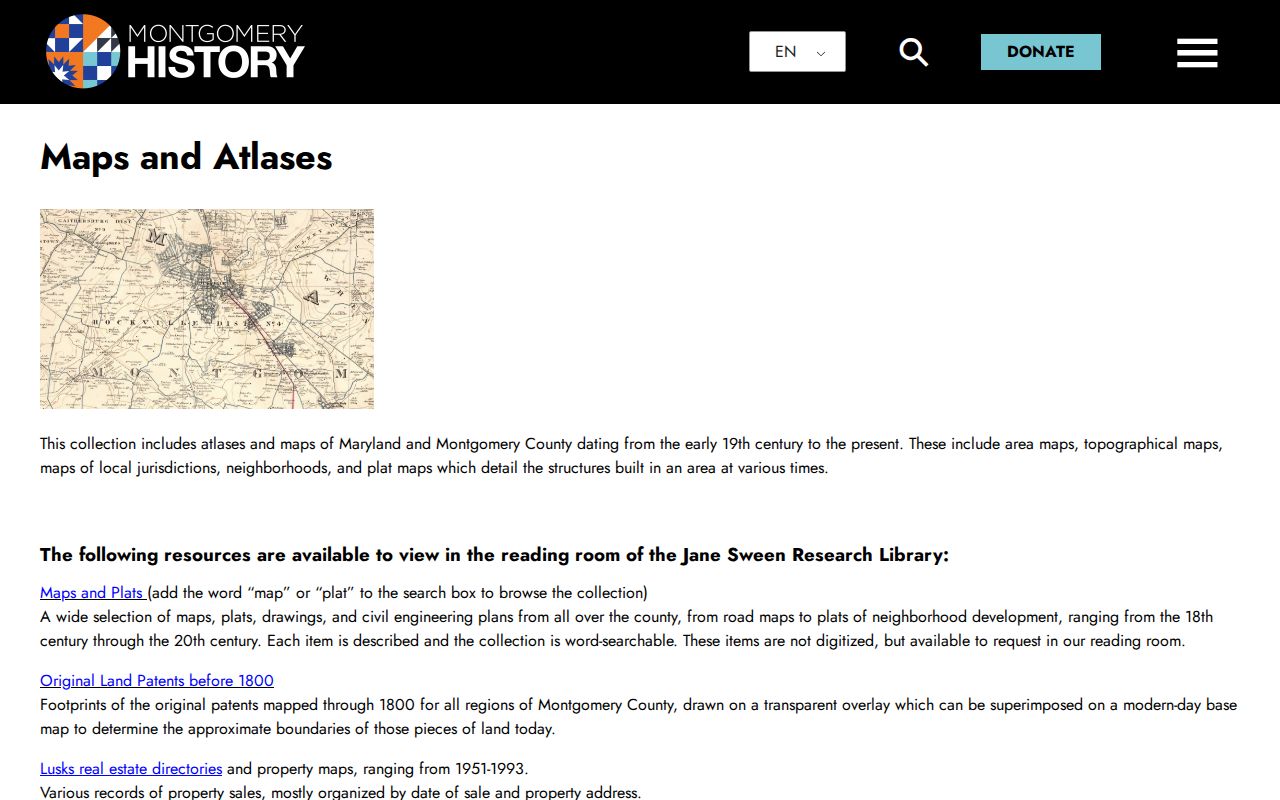
The collection helps date a parcel's setting. Occupancy, though, stays a person-specific question answered only by dated resident records.
Germantown House-History Limits
Montgomery History's property-research guidance makes an important point for anyone tracing past residents of Germantown. Deeds describe land. They rarely state when a house was built, and older county records are not indexed by address at all. They rarely state when a house was built. Older county records are not indexed by address at all. For unincorporated Germantown, house plans may have stayed with the builders or been thrown away, and only limited blueprints survive. House plans may have stayed with the builders or been thrown away. Only limited blueprints survive. A missing plan proves nothing about permits, owners, or earlier structures on the parcel.
When a local file is not online, the archive and its research service are useful fallbacks. A local file may not be online. The archive and its research service are useful fallbacks. The archive works by appointment, and reading-room rules permit photographs or scans. Its published research service costs $50 for the first hour and $30 for each additional hour, with $0.50 copies and a typical 8–10 business-day turnaround. The first hour costs $50. Each additional hour costs $30. Copies run $0.50, and the typical turnaround is 8–10 business days. Requests over 100 pages are not accepted. These are research options, not a finished house dossier.
The property-research guide illustrates the SDAT-to-deed and legal-description method.
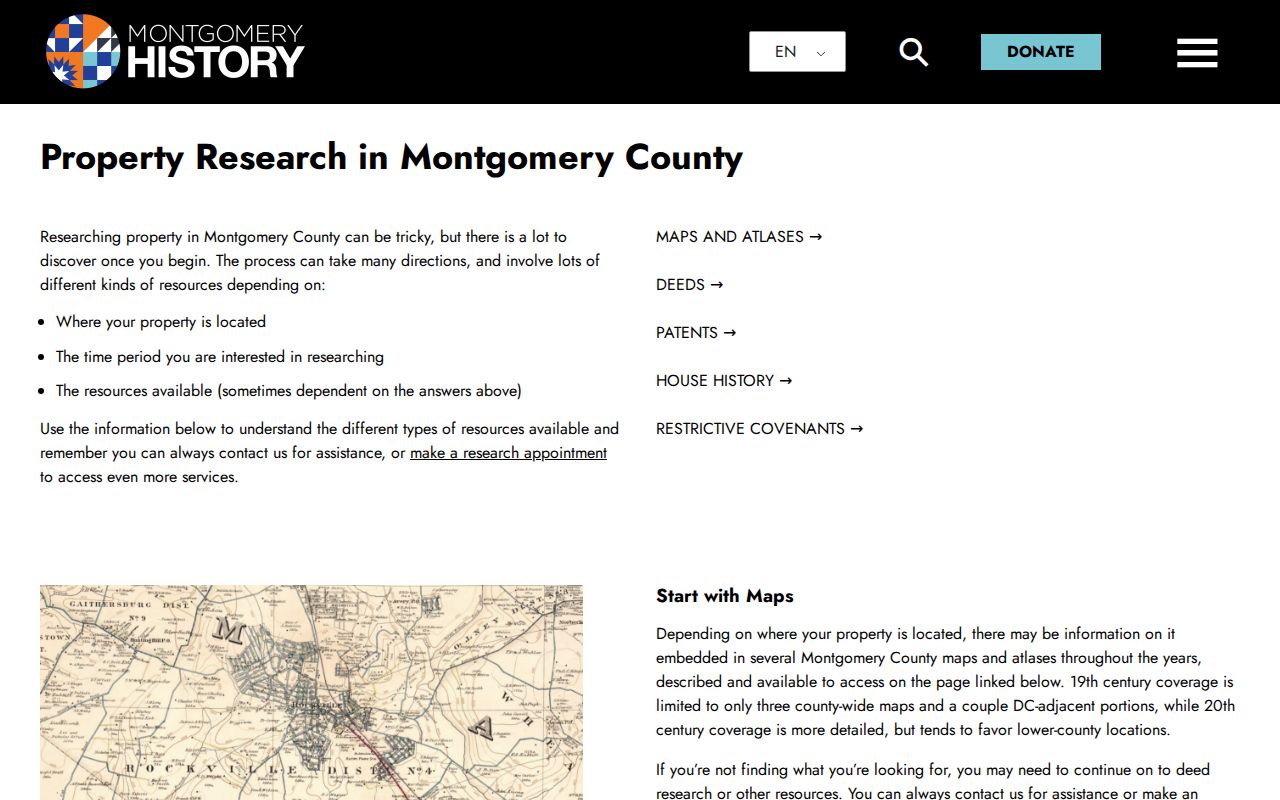
The method rewards patience. Build a chain of records instead of waiting for one database to settle every house-history question.
Past Households in Germantown Records
Recorded owners are just one layer of past residents of Germantown. Boyd's 1879 county directory can yield address clues. So can a 1935 Maryland telephone page, documented Nelson and Polk regional volumes, and later maps. A criss-cross section, where a volume has one, works backward from an old street to a listed name. The Germantown city directory collections page describes the holdings. Lean on their year and page evidence rather than carrying a name forward without a dated source.
Pair every directory date with a released federal census. Census entries give ages, relationships, and places. A directory may add an address or telephone clue. Then check the location against the deed or parcel legal description. This flow matters. A deed party might have owned land elsewhere, and a directory entry alone may be too thin to prove the same parcel for prior residents.
- Record the directory's name, locality, printed notation, year, and page.
- Check adjacent directory years for a move, title change, initials, or residence notation.
- Compare the date with the matching released census and preserve disagreements as separate snapshots.
- Use the legal description, map, or plat to test whether the historic location is the modern parcel.
- Search Sentinel notices, cemetery cards, probate files, and estate conveyances for a death, executor, heir, or later transfer.
Montgomery History documents Sentinel coverage from 1855 to 2020 through digitized issues, reading computers, microfilm, and abstracts. An obituary can point to relatives, a church, a funeral home, or an executor. It needs an exact date and page, especially with repeated initials and common names. For an estate, follow the personal representative deed or a later conveyance. Do not assume a relative lived at the address.
Lawful use. Use past-resident research for family history, estate questions, house history, or personal curiosity. Do not use a historical record to stalk, harass, or track a living person; Maryland law prohibits stalking and harassment.